


How might we improve Cohere Commerce’s onboarding and engagement strategies to help retail buyers discover brands more efficiently and encourage higher participation in the review process?



Retail buyers rely on word-of-mouth, trade shows, and digital wholesale platforms to discover and evaluate new brands. However, each of these methods has limitations—trade shows are time-consuming and costly, while digital platforms often have poor search tools, lack transparency, and provide inconsistent product sampling.
Cohere Commerce is a B2B intelligence platform that helps retail buyers discover and evaluate consumer packaged goods (CPG) brands using verified reviews and data-driven insights. The platform aims to streamline vendor discovery, increase retailer-brand transparency, and improve user engagement for both retailers and brands.
We started this project to evaluate Cohere’s user experience and engagement strategy, specifically focusing on:
Reducing onboarding friction for new retailers and brands.
Improving retailer engagement by encouraging more feedback and participation.
Enhancing search and filtering to help buyers find relevant brands more efficiently.
This project is still ongoing but will be finished in the next few weeks. After presentation, Cohere will implement the design recommendations to update their overall design and structure
As a UX Researcher and Interaction Designer, my contributions included:
Leading user research through interviews, surveys, and competitive analysis
Designing and evaluating an interaction map to analyze Cohere’s core user flows
Conducting a heuristic evaluation to identify usability issues in onboarding and brand discovery
Designing and running usability testing to validate our recommendations
Synthesizing findings into actionable design strategies for Cohere’s next product phase
This project was completed in collaboration with my team and presented to Cohere leadership..
To better understand retailer behavior and identify opportunities for improvement, so far we've conducted:
Five in-depth user interviews with retailers across different industries.
A survey pilot test to validate assumptions about sourcing preferences.
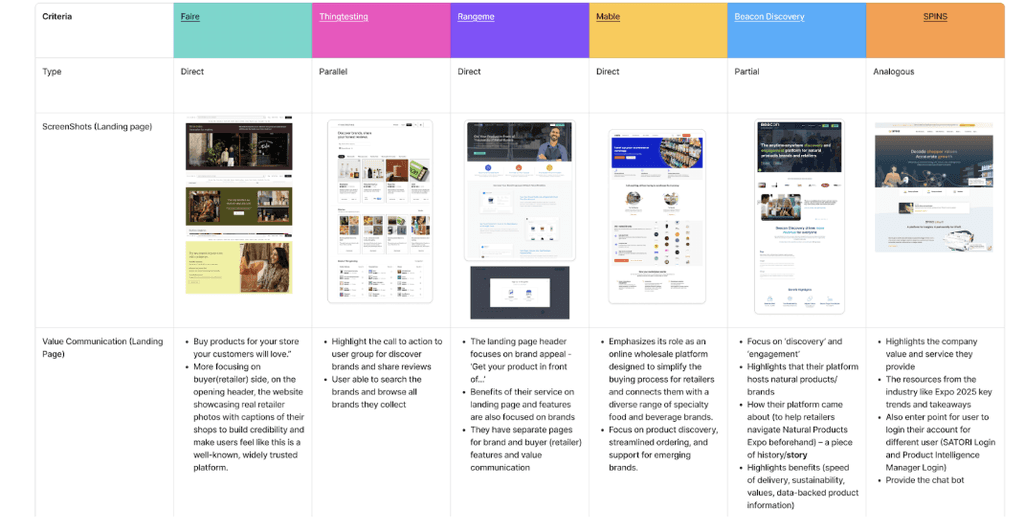
A competitive evaluation of six platforms, including Faire, RangeMe, and Mable.
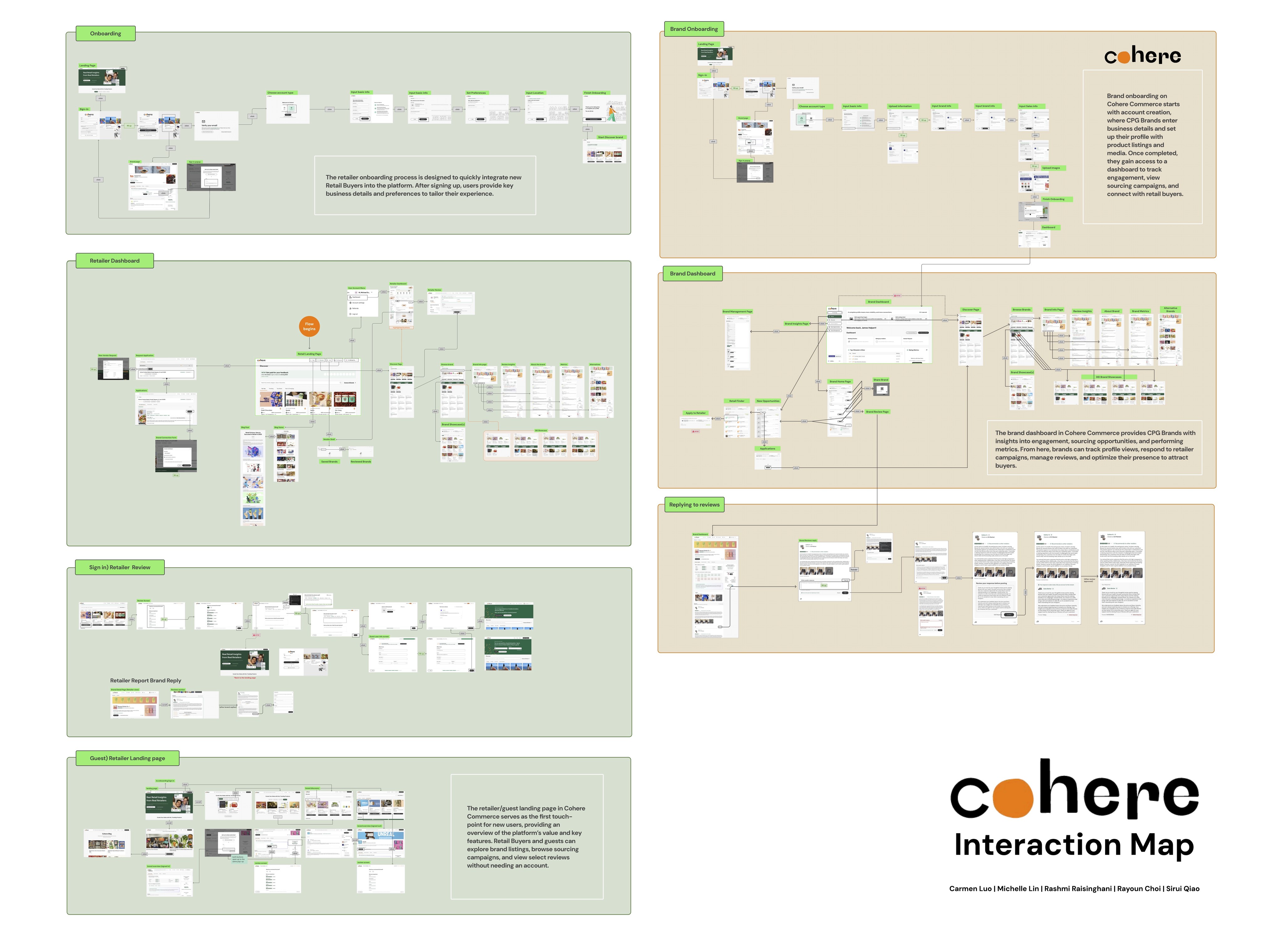
An interaction map analysis to examine key user flows on Cohere’s platform.
Key Findings
Retailers struggle to find local and trusted brands
Many retailers prefer working with local or well-established brands but find them difficult to source online.
Retailers trust word-of-mouth and industry connections more than online reviews.
Poor search and filtering make discovery overwhelming
Retailers feel frustrated by irrelevant search results and want better filtering based on location, sustainability, and values.
Some platforms generate thousands of results with no clear prioritization, making selection difficult.
Inconsistent sample availability affects purchasing decisions
Retailers are hesitant to commit to large purchases without sampling first.
Many vendors offer inconsistent communication and unclear sample request processes, leading to frustration.
Retailers rely on peer recommendations over online reviews
Retailers don’t trust generic star ratings—they prefer to see what other similar retailers are stocking before making a decision.
Many retailers don’t leave reviews because they don’t see immediate benefits.
We analyzed six competing platforms, including Faire, Thingtesting, RangeMe, Mable, Beacon Discovery, and SPINS, focusing on:
Brand discovery & filtering – How do platforms help retailers find relevant brands?
Retailer engagement – What strategies encourage reviews and participation?
Onboarding experience – How easy is it for new users to get started?
Key Findings:
Competitors emphasize value-driven filtering – Most platforms allow retailers to filter by sustainability, certifications, or brand values. Cohere can improve by adding hyper-local sourcing and value-based tags.
Seamless onboarding matters – Platforms with progressive disclosure (step-by-step onboarding) reduce drop-off rates.
Direct messaging and sample requests improve engagement – Successful platforms allow retailers to message brands directly and request product samples easily to build trust.
To further analyze Cohere’s platform, we developed an interaction map that outlines key user journeys:
Onboarding Flow – How new users sign up, explore, and engage with the platform.
Brand Discovery Flow – How retailers search for and evaluate potential vendors.
Engagement Flow – How retailers leave feedback, request samples, and interact with brands.
To validate our qualitative findings, we conducted a survey pilot test on Qualtrics with four participants, including retailers who were previously interviewed.
Key Findings:
Retailers prefer familiar brands – Trust is a major factor in brand selection.
Sample availability influences purchasing decisions – Retailers want an easy way to request samples before committing.
AI-driven recommendations could improve discovery – Retailers are open to personalized brand suggestions based on past purchases and trends.
While the survey sample was small, the insights aligned with our interview findings and competitive analysis, reinforcing our recommendations.
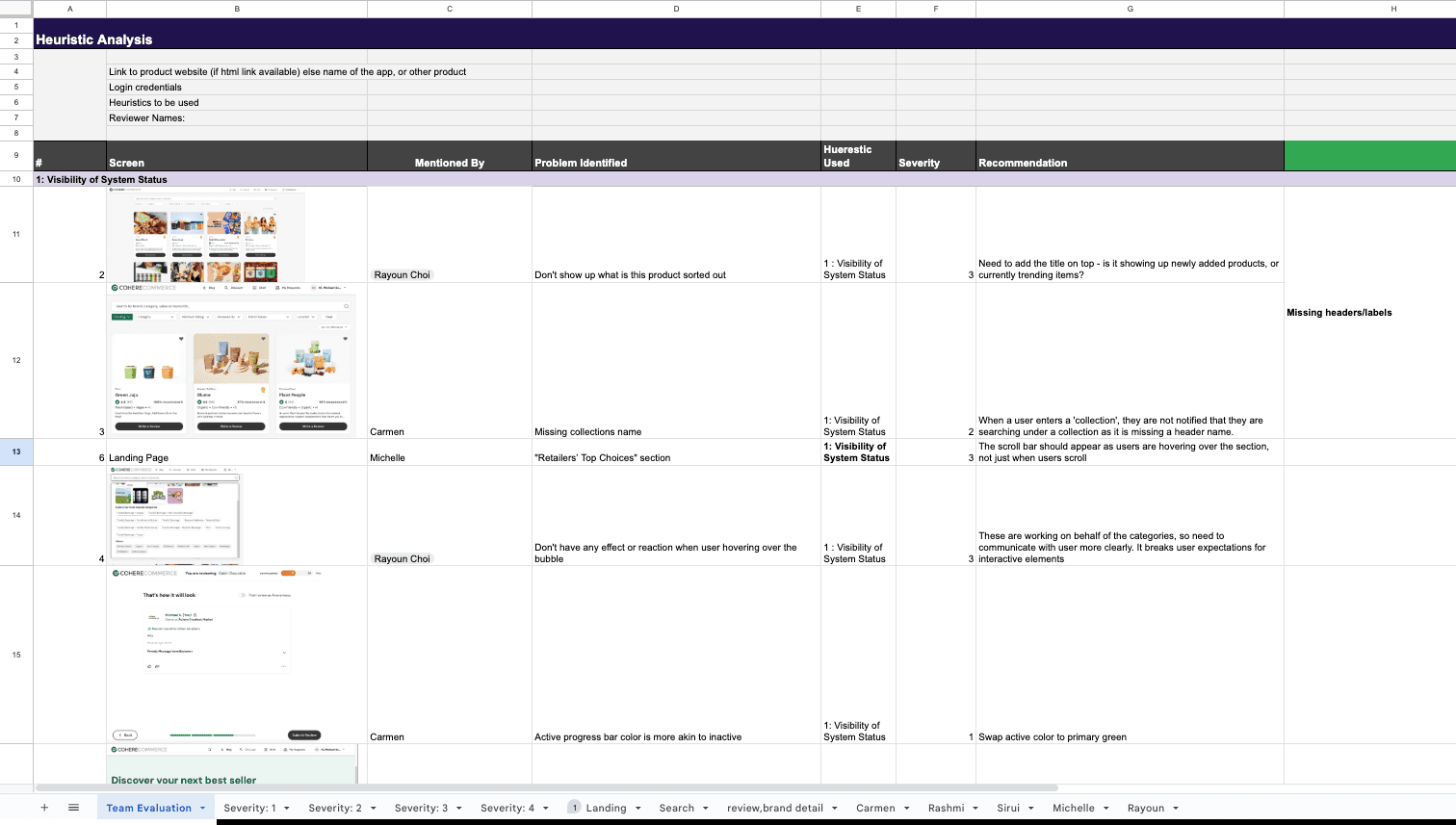
To uncover structural usability issues, we conducted a heuristic evaluation of Cohere Commerce using Nielsen’s 10 Usability Heuristics. Each team member independently reviewed the platform’s core flows (landing page, onboarding, search, brand discovery, brand pages, and reviews). We then consolidated issues, assigned severity ratings, and generated recommendations.
Key Findings:
Navigation and labels were confusing: Two nearly identical search icons and unclear terms like “Shelf” made it hard for users to orient themselves.
Onboarding created unnecessary friction: The flow was long, slow to load, and used a misleading progress bar.
Search was fragile: Small keyword variations often produced inconsistent results, and suggestions lacked brand names.
Critical information was hidden: Important brand details and product lists were buried behind tabs.
AI summaries eroded trust: Summaries appeared even for brands with very few reviews, leading to skepticism.
We designed 5 core tasks for retail buyers: exploring the homepage, signing up, discovering a woman-owned brand, reviewing a brand page, and finding product lists.
Key findings:
Users struggled with excessive onboarding questions
Brand filters were unclear or missing
Sample requests lacked visibility and confirmation
Review submission felt optional rather than encouraged
These findings reinforced our recommendations for streamlining onboarding, clarifying filters, and improving engagement prompts.